
Indy's Major League Baseball Stadium: The History of the Federal League Park
Indianapolis has a rich history with America’s historical past time, baseball. Today, the Indianapolis Indians play minor league, triple-A ball from Victory Field located downtown at West and Maryland Streets. Further back in the city’s history a variety of teams, including earlier iterations of the Indians, and various Negro league teams, have played at several “baseball grounds” established around the city. The more prominent ones included the now defunct Bush Stadium, formerly known as Victory Field and Perry Stadium, which housed the Indians for most of their life. Located along the White River just south of 16th Street, the stadium was later converted to residential use about 15 years ago.
Another ballpark was the famous Washington Park, once located on the city’s eastside, and then relocated to the west side of the White River along Washington Street (near the zoo) where it hosted the Indianapolis Indians until the 1930s. There were also the Indianapolis Base Ball Grounds located at the corner of 16th Street and Capitol, where Methodist Hospital now stands. Riverside Park hosted numerous smaller baseball fields, especially in the early 1900s. The area known as Brighton Beach, covered in this blog post from a few years ago, often hosted teams at fields and small ballparks located along the canal north of 16th Street. These fields hosted a variety of minor league events, local amateur contests, National Nego League games, and local business leagues.

In 1913, another stadium was added to the annals of the Circle City’s baseball legacy: The Federal League Ballpark. The Federal League was an upstart group of teams that planned to challenge the supremacy of the National and American League and operate as a third major league, and perhaps most notably, not abide by salary restrictions existing in the other leagues. Discussions about the league, referred to as an “outlaw” league in local and national press, began to appear in late 1911, when in December of that year, the promoters for the outlaws announced that they would be soon in incorporating the league, and, as described by the press, a “baseball war” would commence. Note: For a full history of the Federal League, check out the articles and books in the sources below.
Teams for the new league were to be located in Indianapolis, New York, Pittsburgh, Chicago, St. Louis, Brooklyn, Baltimore, Buffalo, and Kansas City. Pittsburgh, Chicago, St. Louis already had “major league” teams, so the Federal team would be a direct challenger in those markets. However, the promoters for the Indianapolis team, and others involved with the potential league, downplayed the “war” description.
Despite the discussions in late 1911, nothing definite was established although organization efforts continued, including searches for ballpark sites in the potential host cities. The Indianapolis Star had reported in late 1911, that in this city, “the site of an old cemetery has been selected for the park and the property is in the hands of the promoters of the new league.” The “old cemetery” would turn out to be the defunct Greenlaw Cemetery site on the southwest side of downtown.
It was not until early 1913 when activity with the league became more public. On March 10, the Indianapolis News reported the new league, called the “Federal League,” would soon be incorporated in Indianapolis, and the local team was in the process of obtaining managers and a site to play. Sites for the ballpark that were under consideration were Riverside Park, Wonderland (an amusement park on the east side), the former Greenlawn Cemetery, and a site at River and Oliver Avenues, on the west side of the White River.

A site in Riverside Park was selected, and a ballpark was rapidly constructed in just a few months. On May 5, 1913, the Indianapolis Star published a photograph of the still incomplete baseball park at Riverside. The paper reported that while the grandstands were ready for fans, the field was not ready, and there was “considerable work to do on the grounds yet.”

Despite this, the team opened its season on May 10 with games against Chicago. Two days later, an advertisement in the Indianapolis News requested contractors to submit bids for “sodding the grounds” at the ballpark at Riverside Park, an indicator that the condition of the field itself was not quite up to playing standards.

Aside from the hurried preparations for the season, the Federal League spent 1913 as a minor league. By that fall, the league was preparing for its debut as a “major” league for the 1914 season. The Indianapolis team, now dubbed the ‘Hoosiers’ or ‘Hoosier Feds,’ (sometimes shortened to “HooFeds”) would need a larger ball park more reflective of the team’s, and league’s, new position. In late October 1913 final negotiations were taking place for a new location. Three were under consideration: the former Greenlawn Cemetery site (which had been mentioned back in late 1911), a site called the West Washington Street Show Grounds, and a location on Southeastern Avenue. Greenlawn was the preferred site, and on October 29, 1913, a deal to build the Indianapolis Hoosiers new ball park on the Greenlawn site was finalized. This fulfilled a requirement that had been placed on Indianapolis, Cleveland, Chicago, and St, Louis during an earlier meeting of the Federal League owners and management, that each city would need to construct a ballpark within the downtown of their respective cities.
But time was of the essence. With the calendar heading into November, the 1914 baseball season was less than 6 months away. Little action was initially taken in 1913, and it was not until late January of 1914 that the project was commenced. On Monday, January 26, 1914, Indianapolis Mayor Joseph Bell turned over the first shovel full of dirt. According to the News, Bell stated that “baseball is now generally recognized as a clean, wholesome sport, and one in which people in all walks of life find recreation and amusement.” (this was a few years before the 1919 Black Sox scandal).
J. Edward Krause, the president of the Hoosiers, even returned from his home in Florida for the grand opening. He spoke in grand terms, likening the construction of the park to the planting of acorns from which large oaks would grow, and assured those present to the stability of the league and team.
As soon as the ceremony was finished, crews leapt to work on the grading of the site to create the ball field. The grandstands were scheduled to begin construction the following week, with opening day planned for the middle of April. There had been drama related to the work crews on the site even before the festivities hosted by Krause and Bell. Not long after day break, a large group of men appeared onsite in anticipation of potential employment. A pair of Hungarian immigrants arrived seeking work and the large group of “American laborers” already on site, reportedly in the 100s, attacked the two men. Bricks were thrown at the pair, with one striking one of the immigrants on their head, before he and his companion could make their escape. Police were called due to fears of a race riot, although upon their arrival they found the situation had calmed, although no arrests were made. Construction continued through the early spring of 1914.

By April 4, it was reported that “finishing touches” were being made to the ballpark in advance of the April 23 opening day against St. Louis, while a public open house was scheduled for April 13. An image in the News (above) shows the grandstands in place, although the field itself still appears to be mostly dirt. 4,000 opera chairs had been purchased for the ballpark’s grandstands, which were supplemented by box seats and bleachers further down the baselines and in the outfields.
On April 12, the gates to the ballpark were swung open to the public. The facility, which cost $250,000, was “practically complete,” Grandstands were in place, with the field facing the southeast. The western arm of grandstands was 252 feet in length, while the northern arm was 268. The grandstand was 70 feet high. The right foul line was 310 feet, while the left was 380 (or 370 in some sources). The centerfield depth was 400 feet.

Pavilions, or bleachers, on the end of each grandstand had benches, while the grandstands used the opera chairs. All told, the ballpark could accommodate 19,964, although per a report in the Indianapolis Star, capacity could be pushed to 25,000. The press box was not on field level as was apparently the custom of the day but was behind home plate and higher up on the grandstand. Near there were a group of room dedicated for use by female patrons. Included was a reception room and two restrooms. The reception room was “handsomely carpeted and furnished.” Refreshment stands were also constructed under the grandstands.

Despite all the pomp and circumstance with the establishment of the “outlaw” Federal League, and the expedited construction schedule, not to mention the team’s success (the HooFeds won the league championship), 1914 would be the only year that the ballpark would host its intended team. In early 1915 rumors began to circulate that the league was going to transfer the Indianapolis franchise to another city, with Cleveland and Cincinnati being mentioned as possible locations. These rumors were denied or downplayed, but by March the effort to move a team was underway. At first, the Kansas City franchise had been targeted for a move to the east coast, since the league management wanted a team in, or near, New York City. The other major league teams in New York prevented any inroads in that city, so Newark, New Jersey was selected.
However, legal action against moving the Kansas City team was initiated, preventing the move. The league’s executive committee then presented a proposal to purchase the Hoosier Feds via a stock purchase agreement, although the team’s ownership opposed this. It was anticipated that the purchase would result in the team moving to either Kansas City, and that team then moving to New Jersey, or for the Hoosier Feds to move to New Jersey. Harry Sinclair, the founder of the Sinclair Oil Company, was promoting a Newark team, and purchased the Kansas City franchise with the intention to relocate, before being stymied by the legal action. On March 19, Sinclair stopped in Indianapolis while on his way by train from St. Louis to New York. He met with Federal League leadership (Indianapolis was often the host city meetings of league leadership) and then departed. Rumor was that Sinclair also had his sights set on purchasing the Hoosier Feds, and he would later obtain the rights to the New Jersey franchise.
Over the evening of March 23 into the 24th, the stockholders of the Hoosier Federals voted on the league’s offer. The headline on the sports section of the Indianapolis Star on the morning of the 24th told the story: “Stockholders Agree to Sell the Hoofeds to the League.” The vote had been unanimous and saw the League assuming the club’s significant debts. While the Hoosier Federals had been successful on the field, they had not been as successful on the financial side of things. While it was not expressly acknowledged, it was generally understood that the team would be immediately transferred to New Jersey, and the ownership of Sinclair. The 1915 season opened with no Federal League team in the Circle City.
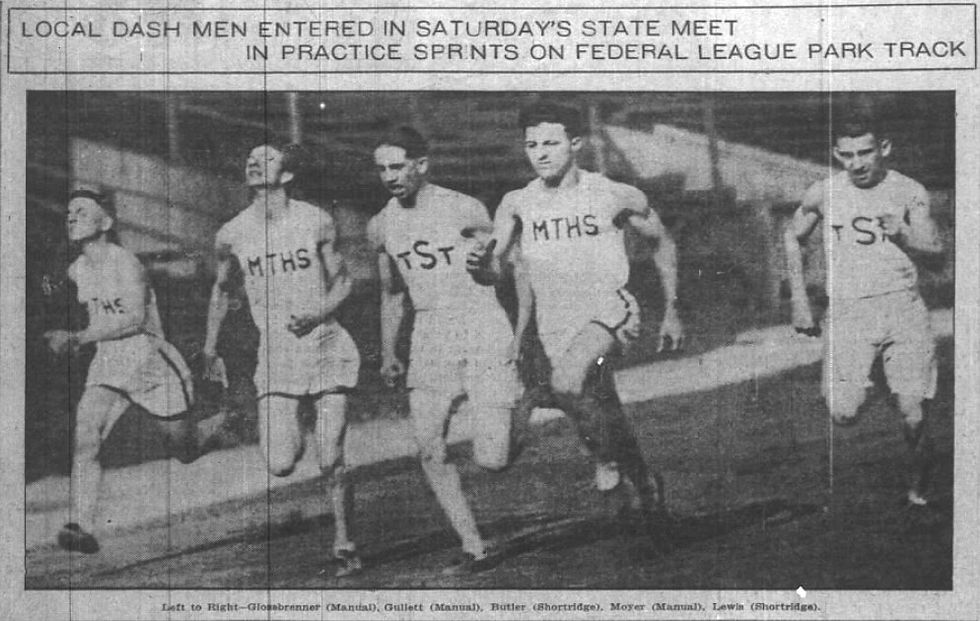
The Federal League’s life in Indianapolis was short, but the league's remaining life was even shorter. By the end of 1915, the Federal League, hobbled by significant financial losses, was shut down. The Federal League Park in Indianapolis outlived the league and continued to operate, hosting various minor league and amateur baseball games, including games between local companies and businesses. The Indianapolis ABC’s, a Nego League team, would also frequently play games at the park. In August of 1915, a game against the ABCs and the West Baden Sprudels, was advertised at the park. The ballpark also hosted track and field events and football games.
However, by 1917, the land where the ballpark sat was targeted for other uses. The Union Traction Company, one of the major interurban lines which served Indianapolis, obtained the land for the construction of new freight houses and depots. The ballpark was demolished although reports indicated that some of its fixtures, including seats and other fixtures, were purchased by other ball clubs for use at their stadiums, or by local businesses.
Today, the land once occupied by the park is vacant. Following the construction of the Union Traction freight houses, the property continued to be used for railroad purposes. At some point, the freight houses were converted to warehouses. The Diamond Chain Company had built a large manufacturing complex on the ground just to the north of the former ballpark site, and this continued to operate for the next nearly 100 years, eventually expanding south into the site of the ballpark. Following the closure of Diamond Chain, the Keystone Group obtained ownership of the land, and the Diamond Chain buildings were demolished in 2023. As was widely reported locally, Keystone Group sought to construct a new soccer stadium (along with various other multi use projects) on the land for the Indy 11 soccer team, with the hope of one day hosting a major league soccer team at the stadium. The images below are the 1916 Baist Atlas, which shows the vacated grandstands of the Federal Legue Park in yellow, and a modern aerial image of the site.
However, the site of this stadium includes not only the Greenlawn Cemetery, but other burying grounds which had been used by the city over the course of 200 years. While repeated efforts were made to remove remains from Greenlawn and adjacent sites in the late 1800s and into the 20th century, remains continued to be found throughout the 20th century during construction projects and other activities on the site. Remains have continued to be found at the site, and the city recently completed a survey and excavation on property it owns along Henry Street (which was on the southern end of the Federal League Park site), where over 1,700 grave shafts were identified. A full survey of the ground that would have been occupied by the proposed soccer stadium has not been completed, so there is no telling how many remains are still in place. A full and complete survey should be conducted before anything else is constructed on the former Greenlawn/Federal League Park/Diamond Chain site.
Interestingly, during the rapid construction of the Federal League Park in 1914, news reports mention nothing about the work crews discovering human remains. However, a report in 1917, over a year after the Federal League ceased operations, indicates remains were found. “In 1914 the city transferred its Greenlawn holdings to the Federal baseball interests, and another exodus of skeletons began,” stated the Indianapolis News, after reporting on prior efforts to remove the remains from the Greenlawn site. “Graves were opened and the remnants were taken to Crown Hill for burial.” As more recent history has shown, not all the remains were removed during the Federal League Park construction, or the projects which came later.
Sources
Indianapolis News: November 15, 1911, October 29, 1913, May 12, 1913, January 26, 1914, April 4, 1914, April 7, 1914, April 9, 1914, February 13, 1915, March 20, 1915, March 23, 1915, May 14, 1915, December 20, 1915, March 13, 1916, January 27, 1917,
Indianapolis Star: December 28, 1911, December 29, 1911, March 9, 1913, May 11, 1913, October 30, 1913, January 23, 1914, January 26, 1914, April 12, 1914, April 14, 1914, April 27, 1915
Madden, W.C., "Baseball in Indianapolis," (2003)
Baseball's Third Major League: The Rise and Fall of the Federal League: https://www.diamond-echos.com/baseballs-third-major-league-the-rise-and-fall-of-the-federal-league/
Levitt, Daniel R, "The Battle That Forged Modern Baseball: The Federal League Challenge and Its Legacy," https://archive.org/details/battlethatforged0000levi/page/198/mode/2up


Comments