
A Most 'Pretentious Shelter': The History of the Riverside Park Shelter House
I have researched and written a lot about Riverside Park in Indianapolis. One of the city’s largest parks, and one of the oldest, having been opened in 1898, Riverside has a diverse topography coupled with a wide range of recreation related events and features. Past topics have included the suspension bridges over the White River, the famed bear pit, the lagoons which once flowed throughout the park, a former railroad bridge, the canoe club which was once based at the park, and the history of boating on the river in the park.
But one feature has escaped my research focused eye: the Riverside Park Shelter House. I was not planning on doing a blog post about the shelter, until a photo of it appeared on eBay few weeks ago. The image, which appears to be from a deconstructed scrapbook, is shown below.

The vantage point of the photo is from atop the 30th Street bridge looking back towards the shelter. And really, shelter is a deceiving term. Modern of the usage of the term brings to mind a simple roof covering a concrete pad with picnic tables. The Riverside shelter was not this simple. It was a massive structure, which really dominated the western side of the 30th Street bridge over the river.
Discussions about the need for a shelter house at Riverside began not long after the park opened in 1898. Riverside Park was a constant work in progress in its early years. When it opened, it was mostly woods and former farmland and various features and amenities were gradually added over the years, and heading into 1903, the Park Board turned its attentions to a shelter. “For some time there has been a demand for a shelter house in Riverside Park,” wrote J. Clyde Powers, superintendent of the Park Board, in his 1903 Park Board Report. “It has been more talked about among the people who frequent the park than any other improvement, and I was directed to design a handsome building of large dimensions, something which would do forty or fifty years hence as well as to-day.”

The proposed design was described as a “Spanish mission” or “Moorish” style. Powers noted that Garfield Park had a Japanese style of architecture, and that he hoped each city park would have a different architectural style. It would be two stories, made of concrete or stone, and therefore “fireproof,” with a tile or “tile imitation” roof. Color was described as “buff,” a yellowish-brown color, with a red or orange roof. The shelter was square shaped, 120 x 100 feet, with a three-story tower on each of the four corners, which would house office space and restrooms. The first floor would be an open concept, for resting and shelter, while the second floor would host a planned restaurant. A concession area was located at the one end of the first floor, while a staircase would be located in the center of the floor to provide access to the floors. The design also had a partial basement, which was noted to be ideal for the storing of bicycles, among other uses. The large shelter came with a large price tag: $35,000. Plans had been to construct the “pretentious shelter,” as it was described by the Indianapolis News, during the summer of 1903, but the construction contract was not approved, along with contracts for several other projects at other parks in the city, until early September.
However, a dispute arose about the legality of the contracts, the primary contention being that the cost of the contracts could not exceed the money available for its use by the Common Council at the time the contract was made. Instead, the Park Board was looking ahead to its appropriation in 1904 to cover the 1903 contracts. This resulted in the contract being declared invalid, although a new contract was drafted in March of 1904, and the same contractors were used.

Construction on the shelter began during the summer of 1904. The site for the shelter was just to the northwest of the 30th Street bridge over the White River, near where a number of boat docks were positioned, including the location where the "Helen Gould" steamboat docked. The postcard image below shows the shelter with the docks in the foreground, as seen from the east bank of the river.

On Labor Day, the Indianapolis Star reported that while visitors enjoyed the park, roofers were still working on top of the shelter house working on the tile roof. When visitors asked if the city did not allow the roofers to take off for the holiday, they responded that they worked for a company from Chicago and that their company was in a hurry to complete the job. The shelter was completed in late November, too late in the year for the park’s high traffic season, so it would not formally open to the public until the next spring.

The shelter would serve a variety of roles for the park. Aside from being a gathering place for those visiting the park to rest and grab a refreshment (the second floor restaurant does not appear to have materialized), the shelter had lockers available for those using the various golf courses located at Riverside (an athletic shelter house was constructed a few years later which take over the locker duties) It also hosted group gatherings, family reunions, and conventions. In June of 1905, the shelter hosted a picnic for members of the Methodist Church from Frankfort. 1,700 attendees rode the Indianapolis and Northwestern interurban south from Frankfort for the event. The image below from the Indianapolis News shows the formal photograph of the group taken in front of the shelter house.

The shelter’s location was a stone’s throw from the river, and the lack of flood protection, meant that the shelter house was often threatened by the flood waters which at times rampaged across Riverside Park. Floodwaters reached the shelter during the great flood of 1913, which did significant damage to the park and its amenities. Many animals on display at the park as part of the city’s first attempt at a zoo were temporarily housed in the shelter house (likely the second floor) during the flood.

The image above shows the flooding in Riverside Park, probably from the 1913 flood, although it might be the 1937 Flood, which also saw extremely high water levels. The shelter house can be seen in the background behind the tree line.
The flood was not the only elemental challenge for the shelter house when the supposedly fireproof shelter house was gutted by a fire. The 1914 report of the Board of Park Commissioners described the incident: “In December, 1913, the Riverside Shelter House burned, leaving only the outside walls and the towers standing. The steel roof trusses were warped and twisted out of shape and had to be removed. A temporary and gravel roof was laid upon the second floor girders and the top of the wall surmounted with a coping. The windows of the second story were bricked and the whole structure remodeled as cheaply as possible, but in a manner that would give a presentable appearance.”
According to the Indianapolis News, the fire was caused by monkeys, whose winter quarters were on the second floor of the shelter house while their normal quarters were under repair, possibly due to the flood earlier in the year. The News explained that the monkey enclosures had been constructed of pine and tar paper, and heated with a small oil stove, which separated from the enclosures. The News indicated that the monkeys had observed their keeper tending to the stove, somehow managed to escape their enclosures, and the knocked over the stove causing a fire. The fire caught the enclosures aflame which allowed the fire to spread. The heat and flames caused the roof to collapse, and resulted in the deaths of the monkeys, severe damage to the structure, and the destruction of numerous park benches being stored for the winter, and the concession stand on the second floor.
As noted in the park’s 1914 report, repairs were made, but more to get the shelter house back into a usable state, than its past glory. The windows on the second floor were sealed and a temporary roof was installed. In 1927, repairs and renovations on the shelter saw the return of the windows on the second floor, as well as other changes. Two staircases were installed to replace the single stairway in the center of the building. The image below is from some time in the 1950s. Note the windows in place, and the car in the parking lot appears to be an early 1950s Buick (maybe a Roadmaster or a Series 40 Tourback sedan).
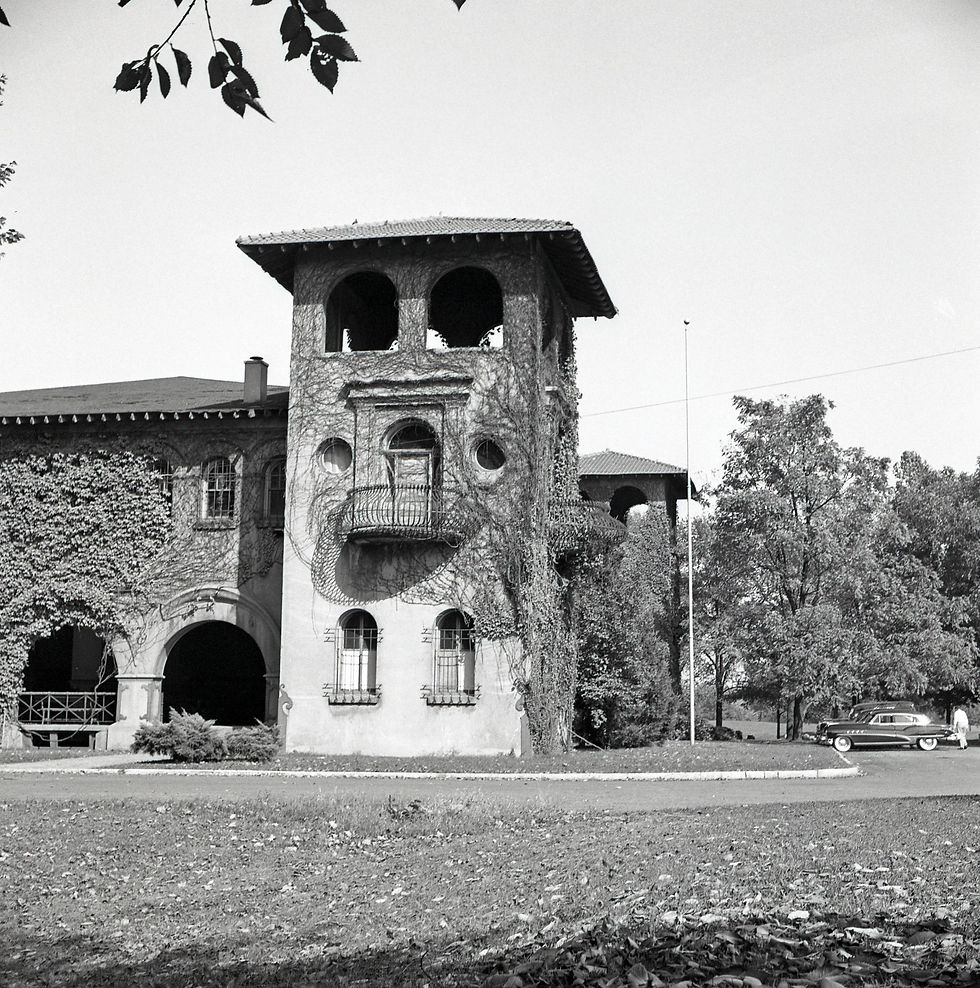
The shelter continued to host visitors and events over the next few decades. It saw the elimination of the bear pit, just to its west, and the relocation of the Indianapolis Canoe Club, which had been on the opposite bank of the river, among many other changes. The second floor was also converted into a rifle range and was used by Navy Reserve personnel from the Naval Armory on the other side of the river for practice.
In 1960 the Herman Hoglebogle column in the Indianapolis News referred to the “deplorable” condition of the shelter, including restroom which “would make anyone sick,” and numerous windows, and broken glass and other debris strewn about.
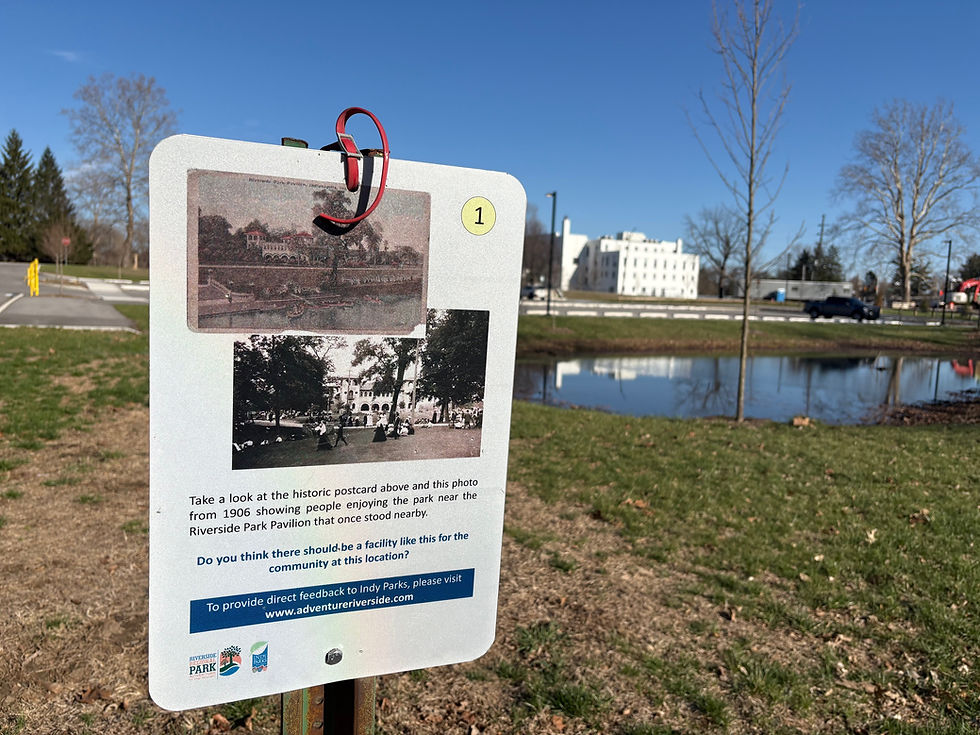
At some point in the early 1960s the shelter house was demolished. I could not find a report in local newspapers about this, nor was it mentioned in the park board minutes. However, aerial imagery shows that between 1956 and 1962, the shelter was demolished. Considering the 1960 reference by Hoglebogle about the shelter’s poor condition, it appears it was demolished between 1960 and 1962. The land upon which it sat remained empty, and even today, part of a parking lot and a retention pond occupy its former site. The image below shows the site of the shelter, looking east, towards the river. Indy Parks has installed a sign showing some images of the shelter house and some historical information.
Going back to the image from eBay, this may have been taken between 1913 and 1927, since it appears the windows on the second level and the towers are sealed. The same view from the 30th street bridge, is shown below in a ‘then and now’ for the site.
Sources
Report of the Indianapolis Board of Park Commissioners for 1903,
Report of the Indianapolis Board of Park Commissioners for 1904, https://www.digitalindy.org/digital/collection/ipr/id/35671/rec/11
Report of the Indianapolis Board of Park Commissioners for 1914
Report of the Indianapolis Board of Park Commissioners for 1914, https://www.digitalindy.org/digital/collection/ipr/id/122397/rec/10
Board of Park Commissioners Meeting minutes, 1956, https://www.digitalindy.org/digital/collection/ipr/id/15027/rec/2
Indianapolis Journal, February 1, 1904
Indianapolis Star: July 4, 1903, September 6, 1904, December 1, 1904
Indianapolis News: July 4, 1903, September 11, 1903, June 2, 1905, March 29, 1913, June 24, 1960
Riverside Park Architectural and Landscape Design Materials, Ball State University Library, https://dmr.bsu.edu/digital/collection/IndplsPDArc/id/7276/rec/15


Another great article. I spent 8 years drilling at the Armory and didn't know the location of the shelter house was across the river. A lot of history in that area. Thanks for all you do.